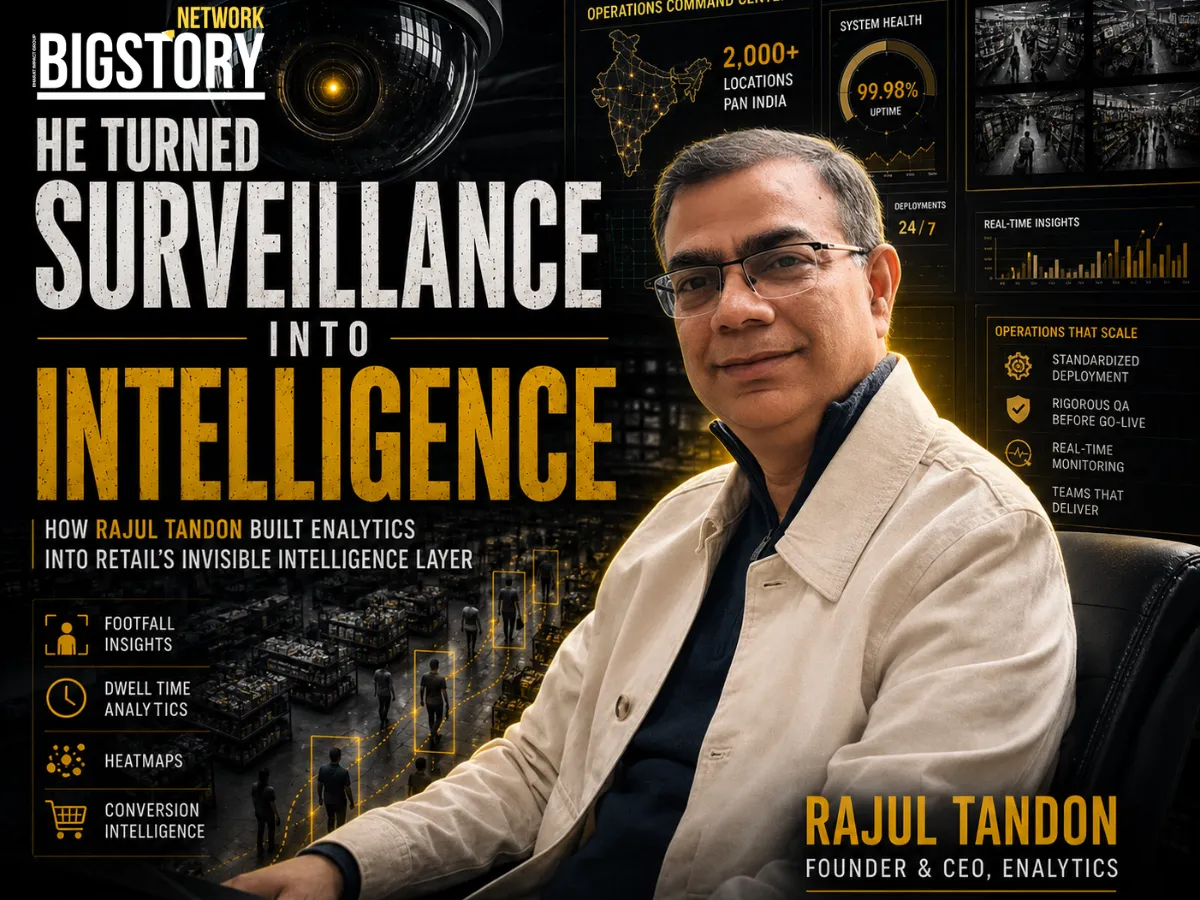
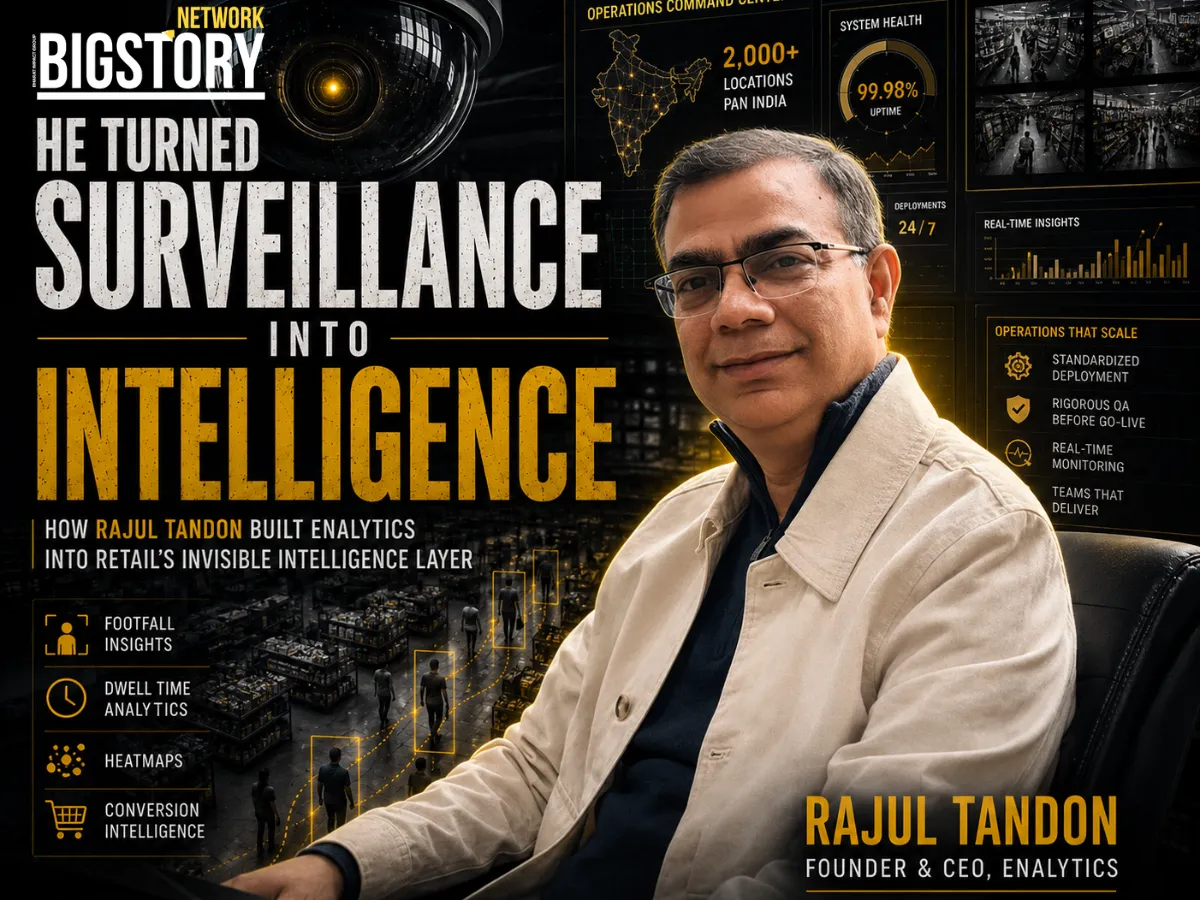
India's retail security ran on guards staring at screens. Rajul Tandon flipped the model; turning passive CCTV into a live data engine now running 2,000+ locations.
 Brajesh Mishra
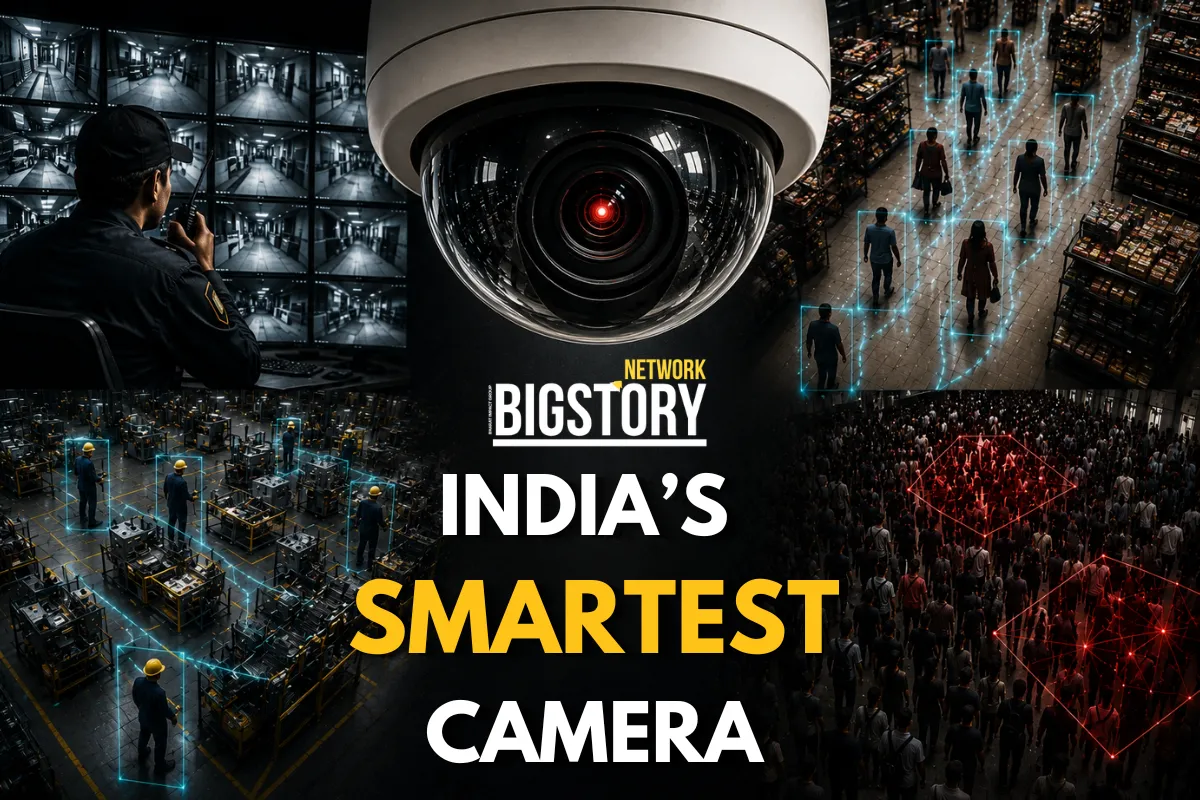
For decades, the Indian retail security playbook relied on a single, fundamentally broken premise: a human being staring at a wall of CCTV screens.
If a theft occurred, a dispute broke out, or a compliance protocol was breached, a guard was expected to manually rewind and blindly scrub through hours of footage just to find a fraction of a second of truth. It was a system built on exhaustion. Rajul Tandon summarized the operational absurdity in one sentence: "It was like trying to find Waldo in a power outage."
But Rajul didn't just see a staffing issue; he saw a massive, two-front data failure hiding in plain sight. Millions of cameras were hanging from ceilings across the country, acting as passive, recording devices. They were only being utilized for the 1% of the time when something went wrong. The other 99% of the time? They were recording the most valuable, untapped asset in physical retail: actual consumer behavior.
His blueprint for disruption was built on a highly pragmatic, dual thesis. First, the industry doesn’t need a smarter guard; it needs a smarter system. Second, surveillance footage shouldn't just be for security; it must be actionable data for brands. That dual realization became the foundation for Enalytics. Rajul didn’t just automate the security desk, he took a traditional corporate cost center and flipped it into a real-time data engine. Today, that engine is bypassing the guard entirely, extracting walk-in counts, heatmaps, and peak-hour metrics that dictate boardroom decisions for over 2,000 retail locations across India.
Rajul didn’t just want to build another software tool; he wanted to pull the Indian IT industry out of a decades-old comfort zone. Before founding Enalytics, he had spent 20 years navigating the global IT ecosystem across the US, UK, and India, running a successful service company.
But he saw a ceiling. The Indian IT sector was structurally addicted to being a service provider which was a massive back-office consumer of technology rather than a global product creator. Rajul knew that in services, you have to prove your value every single time you deliver. A product, however, scales independently of human hours.
To execute this pivot in the middle of a global lockdown, he built Enalytics on a set of brutal, uncompromising rules that defy standard startup advice:
Play 1: The 40/60 Reality Check:
In an era where fresh graduates are obsessed with coding apps, Rajul’s foundational rule is a massive reality check: Technology is, at most, 40% of a successful business. The remaining 60% to 70% is the unglamorous non-tech work identifying the exact pain point, navigating enterprise procurement, and hitting a price point the market can actually digest. "Pilots are not business, and prototypes are not products," Rajul states. In a world where ChatGPT can spit out code in three days, the moat isn't the software; it's the operational integration.
Play 2: The "Zero to One" Hustle & The Enterprise Ego:
Pitching a tech upgrade to the physical retail sector is notoriously difficult because, as Rajul notes, Indian retailers refuse to be the first to try something, but they absolutely hate being second. So how did Enalytics land its very first enterprise client? Rajul is brutally honest: They didn't start with a glamorous launch. They targeted large apparel chains, bypassed the local store managers, and pitched the CXOs at headquarters with a heavily discounted pilot. He did this because he knew that large, pan-India operations desperately needed to become technology-dependent rather than person-dependent. Once that first pilot proved the value proposition, he weaponized FOMO (Fear Of Missing Out) to scale across the rest of the industry.
Play 3: The MVP Survival Law:
Most founders build a Minimum Viable Product, make a couple of sales, and assume they have product-market fit. Rajul calls this a fatal error. The product that actually scales an organization is rarely the first or second iteration; it is the sixth. "Even giants like Nokia and Blackberry died because they stopped innovating," he notes. To survive B2B SaaS, the evolution cycle can never stop.
Play 4: Privacy as a Commercial Moat:
While competitors rushed to scrape as much data as possible, Enalytics made a highly contrarian move: they explicitly excluded facial recognition as a core standard feature. Rajul enforced a "privacy-first" architecture, blurring faces and converting them into anonymized digitized signatures. By becoming STQC compliant and refusing to handle toxic data without strict employee consent, Enalytics didn't just avoid regulatory landmines they built a massive trust moat with billion-dollar enterprise clients.
Today, Enalytics isn't just watching stores; it is optimizing them.
What started as a pandemic-era tool to monitor mask compliance has evolved into a cross-industry analytics juggernaut. Rajul's vision has transformed dead CCTV feeds into real-time operational engines—measuring workstation throughput in manufacturing units, optimizing air conditioning usage based on occupancy, and preventing stampedes in public stadiums.
Rajul Tandon didn't just build a successful AI company. He challenged the deeply ingrained premise of Indian IT, proving that India doesn't just have to be the world's service desk. It can be the architect of the products that the rest of the world consumes.
"You are surrounded by passive systems masquerading as active solutions. The cameras are recording, but no one is watching. The data is flowing, but no one is deciding. If your business model requires a human to manually dig through the dark to find the truth, your model is already obsolete. Stop selling hours. Stop building smarter guards. Start building smarter systems."
At BIGSTORY Network, we believe that the most important entrepreneurial stories are not the ones told at the peak. They are the ones told from inside the climb—messy, uncertain, and real. Because somewhere between a security guard staring blankly at a wall of screens and a massive retail ecosystem running smoothly on real-time data, there was an operator who simply refused to accept the baseline. Not the service-provider mindset. Not the broken legacy systems. But in the idea that India could architect the solutions the world relies on, and that he was the one who had to build the engine.
 Exclusive Content


Sign up for the Daily newsletter to get your biggest stories, handpicked for you each day.



 Trending Now! in last 24hrs